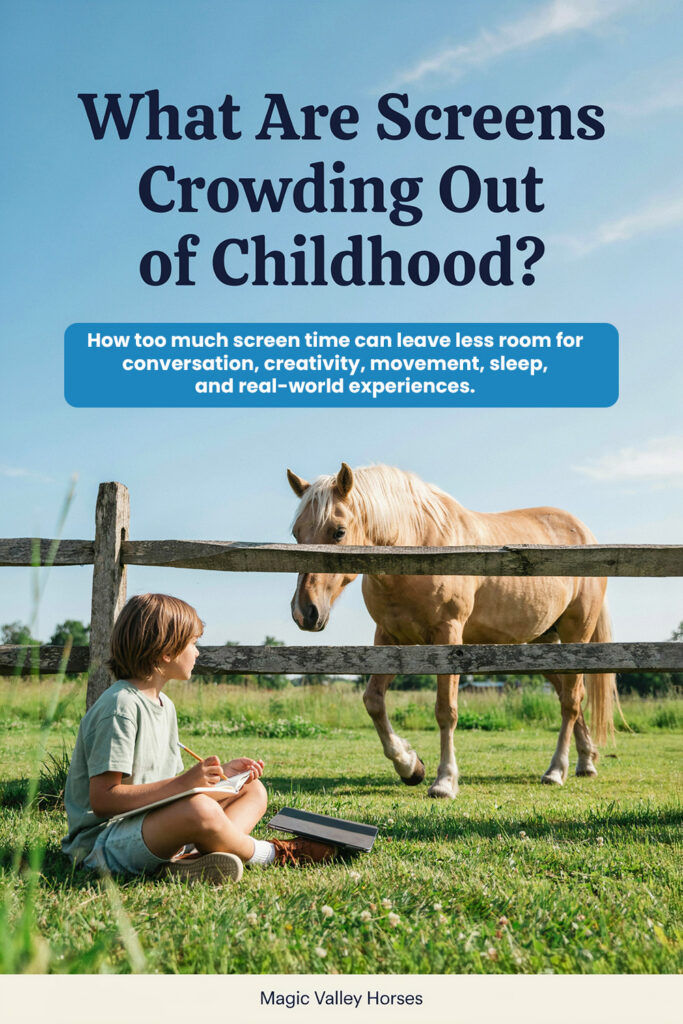
Not long ago, I was visiting a friend while her grandsons were there. Both boys are bright, curious kids. The older one loves to read and can disappear into a book for hours. But when I walked in, both were absorbed in their iPads. I got a quick hello, and almost immediately their attention went right back to the screens.

It wasn’t a dramatic moment, and I’m certainly not suggesting that an iPad has somehow made them antisocial. But it did make me wonder about all the tiny interactions children may be missing when so much of their attention is focused on a screen.
A greeting when someone walks into the room. A conversation that starts because there’s nothing else going on. Looking out the window and noticing a bird. Picking up a pencil and drawing. Wandering outside because you’re bored and discovering a bug you’ve never seen before.
None of those things seems particularly important by itself. Together, though, they’re part of childhood.
Screens aren’t going away, nor should they. They can entertain, teach, connect children with people they love, and open up an incredible world of information. The question isn’t whether children should ever use them.
The more important question may be this:
What is all that screen time crowding out?
Because childhood needs time for more than consuming what appears on a screen. It needs time for moving, talking, imagining, creating, wondering, getting bored, exploring—and simply looking up long enough to notice the real world.
This Isn’t About Saying Screens Are Bad
Before going any further, it’s important to say this clearly: screens are not inherently bad.
Technology is part of modern life, and children can use it in genuinely valuable ways. A child might video chat with a grandparent who lives across the country, watch a documentary about horses, look up the name of a butterfly found in the backyard, follow a drawing tutorial, play an educational game, or use technology to create something of their own.
Those experiences are very different from hours spent passively scrolling through one short video after another.
In fact, research increasingly suggests that simply counting minutes of “screen time” doesn’t tell the whole story. A 2024 systematic review and meta-analysis published in JAMA Pediatrics looked at 100 studies involving more than 176,000 children under age 6. Researchers found that the context of screen use mattered—including what children watched, whether the content was appropriate for their age, and whether a parent or caregiver participated with them. Co-use with a caregiver was actually associated with better cognitive outcomes.
That distinction matters.
Watching a nature video together and then going outside to look for the animal you just learned about is one kind of screen experience. Handing a child a tablet whenever there is a quiet moment is another.
The American Academy of Pediatrics has also moved toward a more nuanced way of thinking about children’s media use. Rather than viewing every minute of screen time as identical, its guidance encourages families to consider the child, the content being consumed, how media is used, and—especially important for this discussion—what that media may be crowding out.
 That may be the most useful question of all.
Is screen time replacing sleep? Outdoor play? Reading? Conversation? Creative play? Physical activity? Time with family?
Or simply the opportunity to be bored long enough to wonder, explore, invent, or notice something interesting?
The goal, then, doesn’t have to be a screen-free childhood. For most families, that probably isn’t realistic—or even necessary.
The goal is to make sure technology remains one part of a child’s life rather than becoming the place where most of childhood happens.
And that’s where the conversation about screen time becomes much bigger than the screen itself.
How Much Time Are Children Actually Spending on Screens?
Before we talk about what screen time may be replacing, it helps to understand just how much of it has become part of everyday childhood.
According to the 2025 Common Sense Census, children age 8 and younger spend an average of 2 hours and 27 minutes a day using screen media. On any given day, 1 in 5 children in that age group spends four hours or more with screens.
That average may not sound enormous at first. But two and a half hours a day adds up to more than 17 hours a week—roughly the equivalent of two full waking days.
And screens are entering children’s lives very early. By age 2, about 40% of children already have their own tablet. By age 4, that number rises to 58%, and by age 8, more than two-thirds have one.
Again, those numbers don’t automatically mean something is wrong. A tablet can be used for learning, creativity, communication, and entertainment. But the amount of time involved is worth noticing. Because children only get so many waking hours in a day.
If several of those hours are spent with a screen, they aren’t also being spent running around outside, talking with family, drawing, building, pretending, helping with something around the house, watching an ant carry a crumb, or simply staring out the window and letting their minds wander.
And that is really the heart of the screen-time conversation.
The question isn’t only:
How much time is my child spending on a screen?
It is also:
What might that screen time be replacing?
That answer will be different for every child and every family. But when screen use regularly begins replacing sleep, movement, conversation, creative play, reading, or time spent exploring the real world, the number of hours begins to matter in a very different way.
Screens Can Crowd Out Conversation
One of the things that first made me think more seriously about screen time was something very ordinary.
I was visiting a friend while her grandsons were there. Both boys are bright, capable kids, and the older one is an enthusiastic reader. But when they have their iPads, I notice how completely their attention disappears into them. I may get a quick hello when I arrive, and then their eyes are right back on the screen.
That doesn’t mean the tablets have made them antisocial. It doesn’t mean they aren’t perfectly capable of having a conversation. But it does make me wonder about all the small interactions that never happen because their attention is already occupied.
Those little interactions matter more than we might think.
Children learn to communicate through thousands of ordinary exchanges: greeting someone who walks into the room, answering a question, telling a story, listening while another person talks, noticing facial expressions, taking turns in a conversation, or simply joining in because they’re nearby and something interesting is being discussed.
Research suggests that screen use can reduce some of those opportunities, particularly in younger children.
A 2024 study published in JAMA Pediatrics followed 220 families and repeatedly measured both children’s screen exposure and the amount of talking happening in their homes between ages 12 and 36 months. At age 3, each additional minute of screen time was associated with fewer adult words, fewer child vocalizations, and fewer back-and-forth conversational turns during the day.
That doesn’t mean a few extra minutes with a tablet will damage a child’s language development. The study showed an association, not proof that screens directly caused the difference.
But the larger idea makes intuitive sense: you can’t have a conversation with someone who isn’t available for one.
And this isn’t only about very young children learning to talk.
As children grow, everyday conversation helps them practice explaining ideas, reading other people’s reactions, listening, asking questions, disagreeing respectfully, telling stories, and learning how conversations naturally move from one person to another.
Much of that practice doesn’t happen during a scheduled “social skills” activity. It happens while riding in the car, eating dinner, helping with a chore, visiting relatives, waiting for something to happen—or simply sitting in a room with other people.
When every quiet moment is immediately filled by a screen, some of those opportunities can disappear without anyone really noticing.
The goal isn’t to insist that children give adults their undivided attention every moment they’re in the room. Children have always become absorbed in books, toys, art projects, and their own imaginary worlds.
The difference is worth thinking about, though.
A screen can provide an almost endless stream of entertainment, making it very easy to remain absorbed for long stretches without ever needing to look up and see what else is happening.
Sometimes, one of the simplest benefits of putting a screen down is also one of the most important:
It makes room for another person.
Screens Can Crowd Out Attention
One of the biggest differences between screen-based entertainment and much of real life is the pace. Many digital experiences are designed to keep attention by constantly offering something new: a new image, a new sound, a new reward, another video, another level, another swipe. Real life usually isn’t that fast.
Reading a book, coloring a picture, building something, watching an animal, doing a puzzle, or exploring outside often asks a child to stay with one thing for longer. The activity may not provide an immediate reward every few seconds. Sometimes nothing especially exciting happens at all. That kind of slower attention is a skill in its own right.
Research in this area is still developing, and it would be too simplistic to say that screen use directly causes attention problems. But several studies have found associations between heavier screen use and later difficulties with attention, executive function, or self-regulation, especially in younger children.
For example, research published in JAMA Pediatrics has found links between higher levels of screen use in early childhood and later developmental concerns in areas that include communication and problem solving. Other studies have found associations between greater screen exposure and attention-related difficulties. The important word here is association. Children’s behavior, family routines, sleep, temperament, and many other factors can all play a role.
So the useful takeaway isn’t that a child who enjoys an iPad is destined to have trouble concentrating. It’s that children also need regular opportunities to practice paying attention to things that don’t constantly work to capture their attention for them.
Think about what happens when a child colors a detailed picture. They choose a color. They decide where it goes. They stay inside a small area—or decide not to. They notice they’ve missed a spot. They keep going until the picture begins to look the way they imagined.
Or think about a child watching a horse in a pasture. At first, it may look as though nothing is happening. But if the child watches long enough, the horse flicks an ear toward a sound, swishes its tail, shifts its weight, lowers its head, or walks over to another horse. The interesting part appears only if the child waits long enough to notice it. That is a very different kind of attention from having the next interesting thing delivered automatically.
Children need both stimulation and quiet. They need excitement, but they also need practice staying with something that unfolds slowly.
Sometimes the most valuable thing we can offer a child is not something more entertaining.
It’s enough time to become interested.
Screens Can Crowd Out Imagination and Creativity
Children are naturally creative, but creativity needs room to develop. When a child watches a show or plays a highly structured digital game, much of the experience has already been created for them. The characters have voices. The scenery is finished. The action is moving. The next event is already waiting. That can be entertaining and even educational. But it is different from an activity that asks the child to supply more of the experience.
Give a child a blank sheet of paper, a box of crayons, a pile of blocks, a few sticks in the yard, or a toy horse and suddenly there are decisions to make. What should this become? What happens next? What color should the horse be? Is that stick a wand, a fence post, or a bridge? Is the cardboard box a barn, a spaceship, or a secret hiding place? Open-ended play asks children to invent instead of simply receive.
Researchers who study play and child development have long emphasized the value of imaginative and unstructured play because it gives children opportunities to practice flexible thinking, problem solving, storytelling, and self-direction. The American Academy of Pediatrics has also highlighted play as an important part of healthy development because children use it to explore ideas, relationships, and the world around them.
That does not mean digital activities cannot be creative. Children can draw, make music, write stories, build virtual worlds, or create videos using screens.
The more useful distinction is between creating and consuming.
If most of a child’s screen time is passive—watching, scrolling, tapping through content designed by someone else—there may simply be less time left for the kinds of activities that begin with, “What could I make?”
And those activities do not need to be elaborate.
- A child coloring a horse purple is making a creative decision.
- A child inventing a story about why a horse is standing alone in a pasture is using imagination.
- A child arranging rocks into a tiny corral is creating something that did not exist five minutes earlier.
Even boredom can become part of the process. When there is no ready-made entertainment immediately available, children have a reason to invent their own.
That may be one of the simplest ways to think about creativity:
Children need time when the next idea doesn’t come from a screen.
Screens Can Crowd Out Movement
Children’s bodies are built to move. They need opportunities to run, climb, jump, balance, dig, carry, reach, pedal, throw, and use their whole bodies in ways that simply cannot happen while sitting in front of a screen. That matters because movement is not just exercise. It is part of how children develop coordination, strength, balance, spatial awareness, and confidence in what their bodies can do.
The concern with screen time is not that sitting down for a movie or playing a game is inherently harmful. The concern is what happens when long stretches of sedentary screen use begin replacing active play.
The World Health Organization recommends that children ages 5 to 17 get an average of at least 60 minutes of moderate-to-vigorous physical activity each day. For younger children, the guidance emphasizes several hours of physical activity spread throughout the day, with plenty of active play.
That can sound like another thing for parents to add to an already long list, but it does not have to mean organized sports or structured exercise. Movement can be wonderfully ordinary.
- A child racing across the yard.
- Climbing onto a playground structure.
- Helping carry something.
- Riding a bike.
- Playing with a dog.
- Walking through a pasture.
- Digging in the dirt.
- Following a trail just to see where it goes.
Even quiet activities use the body differently than a screen does. Coloring, cutting, building, molding clay, stringing beads, and handling small objects all give children practice using their hands and developing fine motor control.
And outdoor play adds something else: unpredictability. The ground is uneven. The wind blows. A ball rolls the wrong way. A branch is higher than expected. A horse moves. A bug disappears underneath a leaf.
Children have to adjust. Those little physical problems help them learn how to navigate the real world.
Screens can certainly be part of a child’s day. But bodies need experiences a screen cannot provide.
Sometimes the best thing a child can do is simply get up and go see what happens.
Screens Can Crowd Out Sleep
Sleep is one of the easiest things for screen time to quietly push aside. A child watches one more video. Finishes one more game. Scrolls a little longer. Bedtime gets later, or the mind stays stimulated long after the screen is turned off.
That matters because sleep supports nearly every part of healthy development.
Children need enough sleep for learning, memory, mood, behavior, growth, and physical health. When sleep is shortened or disrupted, the effects can show up the next day as irritability, trouble concentrating, low energy, or difficulty managing emotions.
Screen use can interfere with sleep in several ways.
First, it can simply take up time that would otherwise be spent sleeping.
Second, exciting or highly engaging content can make it harder for a child to settle down.
And third, light from screens used close to bedtime can affect the body’s natural sleep-wake rhythm, especially when devices are bright and held close to the face.
The American Academy of Pediatrics recommends creating screen-free routines around bedtime and keeping devices out of children’s bedrooms at night whenever possible. Sleep experts also consistently advise limiting stimulating screen use before bed.
Again, the goal isn’t to make families feel guilty about an occasional movie night or a child reading on a tablet. The concern is the pattern. If screens regularly stretch bedtime later, interrupt sleep, or become the last thing a child sees every night, they may be crowding out something children cannot afford to lose.
Enough rest.
A quiet transition into sleep.
And the chance to wake up ready to learn, move, talk, and explore again the next day.
Sometimes protecting childhood starts with something as simple as protecting bedtime.
Screens Can Crowd Out Boredom
Boredom gets a bad reputation. We tend to think of it as a problem to solve quickly, especially with children. If they are restless, waiting, or complaining that there is “nothing to do,” it is easy to hand over a screen and make the discomfort disappear.
But boredom can serve a purpose. When children are not immediately entertained, they have to decide what to do next.
 They might pick up a book.
- Draw something.
- Build a fort.
- Go outside.
- Ask a question.
- Invent a game.
- Watch what the dog is doing.
- Notice a bug crawling across the sidewalk.
- Or simply sit quietly long enough for an idea to form.
That space between “nothing is happening” and “I found something to do” can be surprisingly valuable.
Researchers have linked unstructured play and downtime with creativity, problem solving, self-direction, and imaginative thinking. The important point is not that boredom itself is magical, but that children need opportunities to generate their own activity instead of having every quiet moment filled for them.
Screens make that incredibly easy to avoid. There is always another video, another game, another image, another notification, another thing waiting to entertain. And when entertainment is always available instantly, children may get fewer chances to practice creating interest for themselves.
That does not mean parents should deliberately make children miserable or refuse to help when they truly need engagement. It simply means we do not have to rescue them from every quiet moment.
Sometimes “I’m bored” can be the beginning of something useful.
Because boredom can lead to wondering.
Wondering can lead to exploring.
And exploring can lead to learning.
Sometimes boredom is the doorway to curiosity.
Screens Can Crowd Out the Real World
A screen can show a child almost anything. A horse running across a field. A butterfly emerging from a chrysalis. A rainforest, a volcano, a coral reef, even the surface of another planet.
That access is remarkable. But seeing something on a screen is not the same as experiencing it.
A screen cannot reproduce the warmth of the sun on your face, the smell of wet earth, the roughness of tree bark, the feel of horsehair under your hand, or the surprise of finding something unexpected in the grass.
Real-world experiences ask children to use more than their eyes.
- They listen.
- Touch.
- Smell.
- Move.
- Wait.
- Adjust.
- Notice.
And perhaps most importantly, they encounter things they did not choose in advance.
When a child watches a video, the experience has already been selected and packaged for them. Outside, things happen without asking permission.
- A bird lands nearby.
- A horse suddenly lifts its head.
- A beetle crawls across the path.
- The wind changes.
- A cloud takes on a strange shape.
- A seed pod cracks open.
- Those moments invite questions.
- Why did the horse do that?
- What kind of bug is this?
- Where is that bird going?
- Why does this leaf feel different from that one?
That kind of curiosity grows out of direct experience. It is one reason simple activities like walking outside, visiting animals, gardening, collecting leaves, watching birds, or sitting quietly in a pasture can be so valuable. They give children something real to pay attention to.
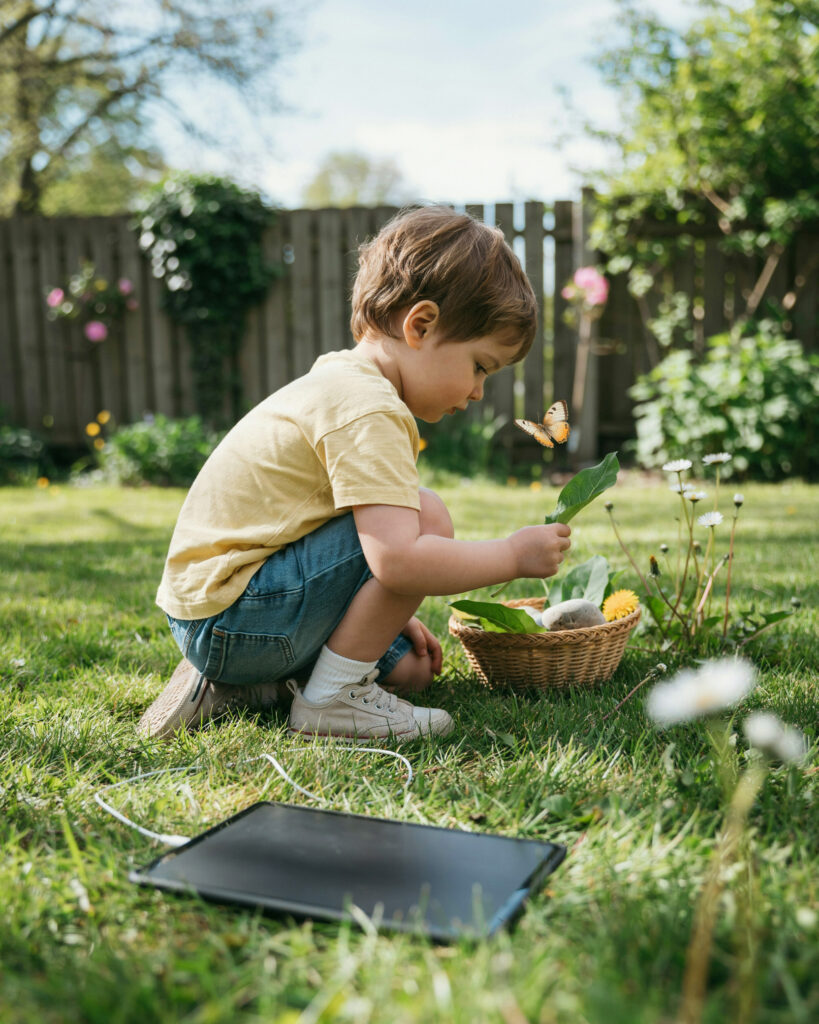 And they encourage one of the most useful habits a child can develop:
Look closer.
Look at the horse’s ears.
Look at the pattern on the butterfly’s wings.
Look at the tracks in the dirt.
Look at the tiny hairs on a leaf.
Look at what changes when you stop rushing and really pay attention.
Screens can introduce children to the world. But they should not become a substitute for experiencing it. Because some of the best learning still begins with a child looking up, noticing something, and asking:
“What’s that?”
Start Small
If screen time has become a big part of family life, changing it can feel overwhelming. It does not have to happen all at once.
Earlier, we talked about the American Academy of Pediatrics’ idea of looking not only at how much screen time children have, but at what that screen time may be crowding out.
That gives parents and grandparents a much more practical place to begin. Instead of asking, “How do we dramatically cut screen time?” ask:
What would we like to make more room for?
- More sleep?
- More conversation?
- More movement?
- More reading?
- More creative play?
- More time outdoors?
- More opportunities to be bored, wonder, and explore?
Then start by protecting one small piece of the day for that. Maybe meals become screen-free so there is more room for conversation. Maybe devices are put away for an hour after school so children have time to move, read, draw, or go outside. Maybe screens are turned off before bedtime to protect sleep. Maybe Saturday morning includes some outdoor time before anyone settles in with a device. Maybe the family simply decides that screens stay home during certain outings so everyone has a reason to look around and notice where they are.
There is no need to throw out the tablets, cancel every streaming service, or create a rigid schedule that becomes one more source of stress. Small changes are easier to maintain, and they give children time to adjust.
There may be complaints at first. That does not necessarily mean the change is a bad one. Children, like adults, get used to routines, and giving up something highly entertaining can be frustrating.
It helps to offer alternatives without feeling responsible for filling every minute.
- Have art supplies available.
- Keep books nearby.
- Suggest going outside.
- Invite a child to help with something you are doing.
Then let some of the time remain unstructured.
Remember, boredom does not always need to be fixed. As we discussed earlier, sometimes it is exactly the space a child needs to invent, notice, create, or become curious.
The goal is not perfection. It is balance.
Even reclaiming one hour a day creates seven additional hours each week for conversation, movement, reading, creative play, outdoor exploration, or simply doing nothing for a while. That is a meaningful amount of childhood.
And over time, those small changes can become habits. A child begins reaching for a book instead of a tablet. Going outside becomes normal again. A walk becomes a chance to notice things. A quiet moment no longer has to be filled immediately.
The objective is not to raise children who never use screens. It is to make sure screens do not crowd out the very things children need most.
We do not have to eliminate technology from childhood. We just have to leave enough room for childhood itself.
Look Up. Look Around. Look Closer.
Screens can show children extraordinary things. They can take them inside a rainforest, beneath the ocean, into space, or into a barn halfway around the world. They can answer questions in seconds and introduce children to animals, places, and ideas they might never otherwise encounter.
But extraordinary things are happening off the screen, too.
- A horse turns an ear toward a sound you didn’t hear.
- A spider builds a web overnight.
- A bird carries a piece of grass to its nest.
- Clouds begin to change before a storm.
- A pencil turns a blank page into something that existed only in a child’s imagination a few minutes earlier.
- Someone walks into the room with a story to tell.
Children need enough unscheduled, unplugged time to notice those things.
That doesn’t require rejecting technology or trying to recreate some idealized version of childhood from the past. Screens are part of the world today’s children are growing up in, and they can be useful, educational, creative, and fun. But they should be part of childhood—not the place where most of childhood happens.
Perhaps the most useful question isn’t simply, “How much screen time is too much?”
It may be:
“What is there still enough time for?”
Is there enough time to move? To talk? To read? To make something? To be bored? To play? To go outside? To notice? To wonder? To ask questions?
Because those ordinary experiences are doing something important. They are helping children discover their interests, practice skills, connect with other people, and learn how the real world works.
Sometimes all we need to do is give them enough space to look up.
Then encourage them to look around.
And every once in a while, ask them to look closer.
Because there is still an entire world waiting beyond the screen.